
YIMBY Arrives in Plymouth
- ron46805
- Jan 21
- 3 min read
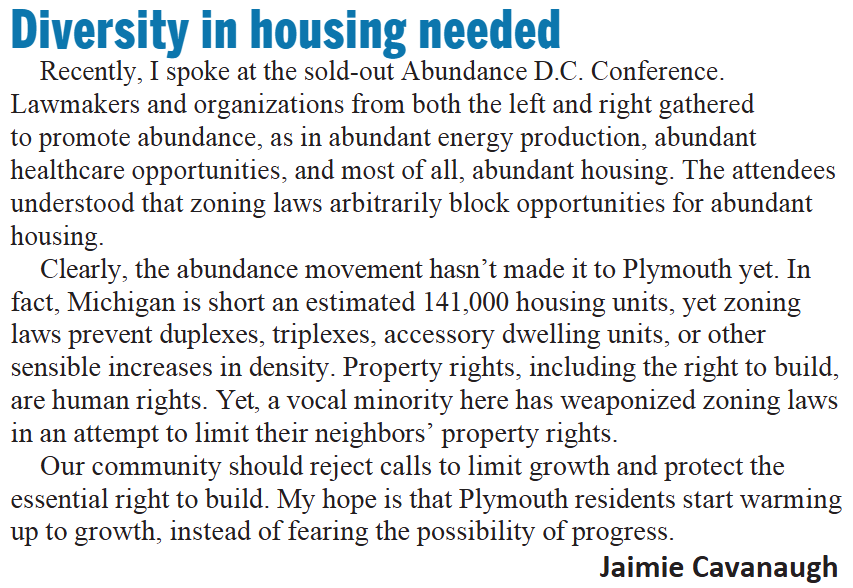
After attending the Local Clubs and Activities Expo at the Plymouth District Library, Jamie Cavanaugh spoke at the January 13 Community Conversation meeting to announce the formation of YIMBY Plymouth.

If you have never heard of YIMBY, a little background is helpful.
YIMBY, short for “Yes In My Backyard,” is a clever rebrand of the old NIMBY, "Not In My Backyard" label. “NIMBY” was a label invented by development advocates to shut down debate. Instead of responding to concerns about specific projects, they branded opponents as anti-change and moved on. No discussion required. Sound familiar?
YIMBY flips that script by claiming the moral high ground right in their name. They aren't like those awful NIMBY folks. Even their branding tells you they are the reasonable people.
Don't let them fool you.
The core YIMBY argument is simple. Cities like Plymouth need more high-density housing to solve the affordable housing problem. On the surface, it sounds compassionate and practical. And of course, anyone who questions it is quickly painted with the same ol' brush. "You must be against poor people". The political left has used that tactic for decades, and they will keep using it as long as it works.
But a few minutes of honest analysis shows how misguided this approach is.
If you were appointed “Affordable Housing Czar” and could place a high-density housing complex anywhere you wanted, would you choose a high property value city like Plymouth?
Take a house two blocks from downtown Plymouth and move it to two blocks from downtown Livonia or Westland and its value would be cut in half. That is not ideology. That is real estate 101, location, location, location.
So a building with 20 apartments two blocks from downtown Plymouth will inevitably charge higher rents than the exact same building in Livonia or Westland. If affordability is truly the goal, which location makes more sense?
Pointing this out doesn't make someone heartless. It makes them honest.
YIMBY is also not a new idea, which means we can look at how it has played out elsewhere. In California, the YIMBY movement doesn't even get along with the “Housing Is a Human Right” activists. That alone should raise eyebrows. You would think groups with supposedly aligned goals would be natural allies.
The reason they aren't is simple. YIMBY’s push to remove development restrictions doesn't result in large amounts of affordable housing. It results in gentrification. The same gentrification Plymouth residents already recognize and worry about.
When we follow the money, YIMBY California is not primarily funded by developers as we may predict. It's funded by Big Tech. That fact alone should prompt questions about whose interests are really being served.
At the Community Conversation meeting, Ms. Cavanaugh made it clear that YIMBY Plymouth is part of a coordinated statewide effort. Why these groups focus their energy on high property value communities remains unexplained.
It's a mystery that developers seem very happy with.
So if YIMBY isn't the answer, what is?
First, we need to be honest. New development in Plymouth isn't going to produce starter homes. Relaxing restrictions may allow developers to pack more people near downtown, but when given the choice, developers will build high end units that maximize profit. That isn't cynicism. That's how markets work.
One meaningful step the city could take is addressing the McMansion trend. Tearing down a $400,000 home to replace it with a $1.4 million house does nothing to help young families move here. It reduces housing diversity and steadily erodes the character that makes Plymouth desirable in the first place.
Preserving smaller, more modest homes helps maintain lower price points and protects the historic charm residents value.
The Planning Commission has been discussing this for more than three years. They have explored a Compatibility Ordinance that would limit the size of replacement homes using a formula based on nearby houses.
Yes, this conflicts with the property rights purist part of my brain. But if I can support keeping marijuana dispensaries out of Plymouth, I can support reasonable limits that preserve the city’s character.
What's missing is action from the City Commission. This issue needs to be added to the one-year goals so the Planning Commission can move forward.
If the City Commission once again declines to act, it may be time for citizens to consider a ballot referendum in November 2026.
Because if we do nothing, the future of Plymouth will be decided for us.


Comments